
New planning laws are now in place. The Ministry for Cities, Environment, Regions & Transport is publishing guidance, tools and updates on this website as the new planning system is introduced in stages.

New Zealand Planning Institute (NZPI) supports the planning profession through membership, professional development and practitioner networks. 

  • Publications
  • About us
  • Contact us

Search

Menu

  • Planning system overview
  • How will it affect you
  • Implementation and guidance
  • Publications
  • About us
  • Contact us

Planning system overview

Find out why the planning system is changing, how the new system will work, and what it could mean for you.

Go to section
  • Why the system is changing
  • How the new system will differ from the RMA
  • How decisions are made
  • What the new system could mean for you
  • When the changes are happening
  • Consents and notices of requirement during the transition
  • Key milestones in the transition
  • When you can have your say

How will it affect you

Find out what the new planning system could mean for Māori, communities, businesses and organisations across New Zealand.

Go to section
  • Māori interests
  • The natural environment
  • Local government
  • Homeowners and landowners
  • Property development
  • Infrastructure
  • Farming and growing
  • Marine environment

Implementation and guidance

Access practitioner information and support for implementing the new planning system with confidence.

Go to section
  • How the new system is being implemented
  • Implementation training and events
  • Transitional consenting
  • Regional spatial plans
  • Land use planning
  • Standardised plan content for district land use plans
  • Natural environment planning
  • Environmental limits
  1. Home
  2. Planning system overview
  3. How decisions are made

Planning system overview

  • Why the system is changing
  • How the new system will differ from the RMA
  • How decisions are made
  • What the new system could mean for you
  • When the changes are happening
  • Consents and notices of requirement during the transition
  • Key milestones in the transition
  • When you can have your say

How decisions are made

Find out how national direction, regional plans and individual decisions work together in the new planning system.

National direction is not new. New Zealand already has national direction on issues such as infrastructure, urban development and renewable electricity generation. However, it is currently spread across different planning documents, making it harder to navigate.

The new planning system is designed to work more clearly and consistently. Decisions made at one level of the system help guide the next stage of planning, rather than reopening the same issues at each step. This is intended to reduce duplication, provide greater certainty, and ensure national priorities are reflected in regional plans and local planning rules.

Goals guide the system

The new system has a clear link between national priorities and local decisions. The goals under each Act set the overall direction for the new planning system. They explain what each Act is designed to achieve and guide planning decisions at every level.

National instruments set priorities and rules

National instruments include national policy direction and national standards. They help turn the goals of each Act into planning rules and decisions.

National policy direction sets out national priorities and provides direction on nationally important issues such as housing, infrastructure, natural hazards and the environment.

National standards and regulations support this direction by setting consistent processes, rules and planning requirements across the country. They help shape what councils include in their plans and how those plans are applied.

Spatial plans shape regions

Regional spatial plans give effect to national policy direction and national standards at a regional level. They set the long-term direction for growth and change in a region for the next 30-plus years.

See regional spatial plans.

Plans apply direction locally

Land use plans under the Planning Act set the rules for how land can be used and developed. Natural environment plans under the Natural Environment Act set the rules for how natural resources are used, protected and managed.

These plans put national direction, national standards and regional spatial plans into practice. They do this through tools such as zones, rules, designations, limits and overlays.

Consents and permits make activity decisions

Councils then make decisions on consents under the Planning Act and permits under the Natural Environment Act.

By addressing more issues earlier in the process, the new system is intended to be more efficient and predictable. It gives councils, applicants and communities greater clarity about what has already been decided and where decisions still need to be made.

Figure 1: System architecture diagram
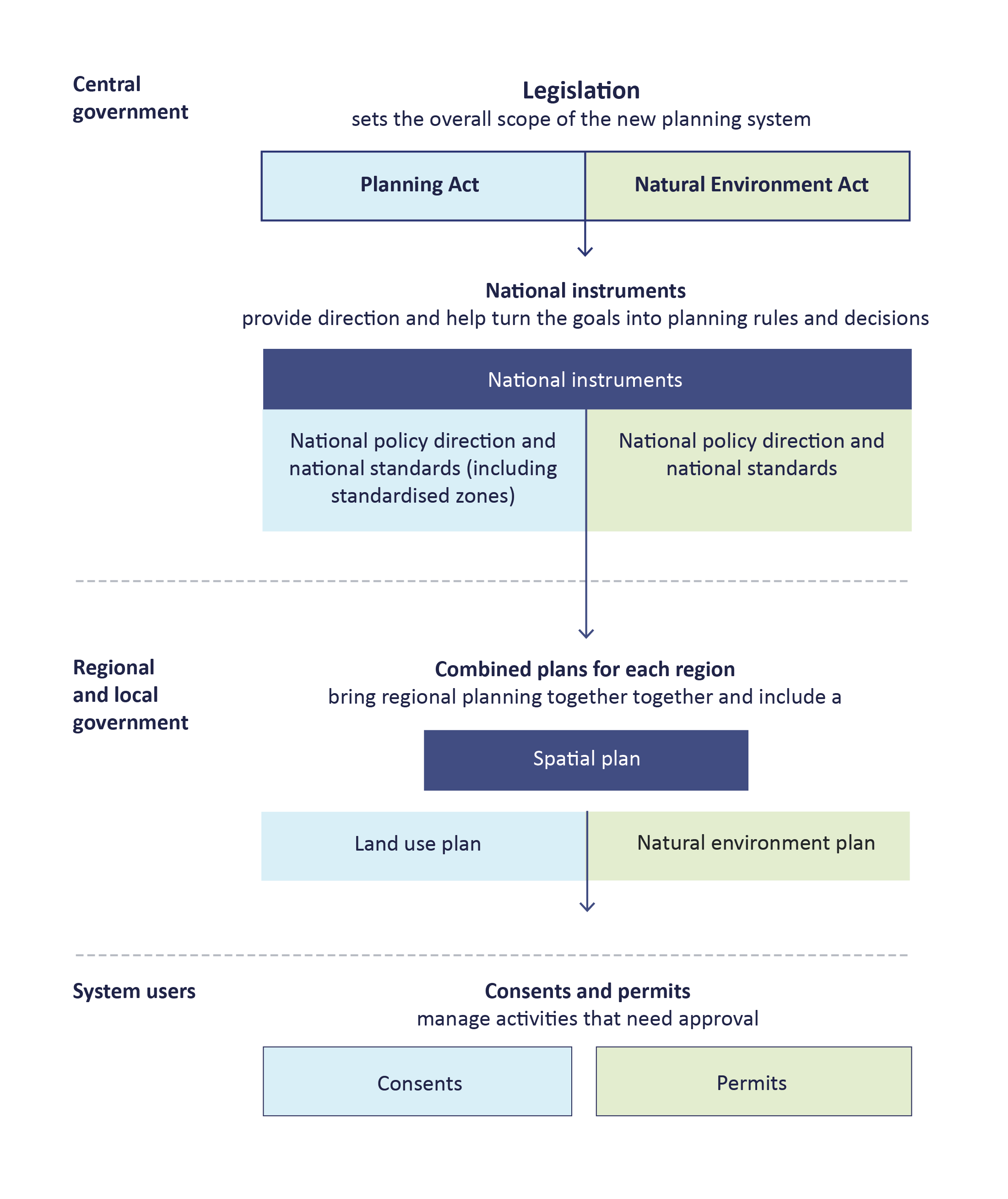
Diagram showing how legislation, national instruments, regional plans, and consents and permits work together within the proposed planning system.

Planning system overview

  • Why the system is changing
  • How the new system will differ from the RMA
  • How decisions are made
  • What the new system could mean for you
  • When the changes are happening
  • Consents and notices of requirement during the transition
  • Key milestones in the transition
  • When you can have your say

Helping New Zealand plan, build, grow and protect what matters

About

  • About this website
  • Contact us

Our work

  • MCERT (opens in a new tab)

Contact

  • 0800 499 700
  • planning@mcert.govt.nz

Footer

  • Privacy statements
  • Copyright
© 2026 Planning.govt.nz