About the roles and responsibilities for developing regional spatial plans
The following diagram and table show the different groups with responsibilities for developing spatial plans.
Figure 1: Groups responsible for developing spatial plans
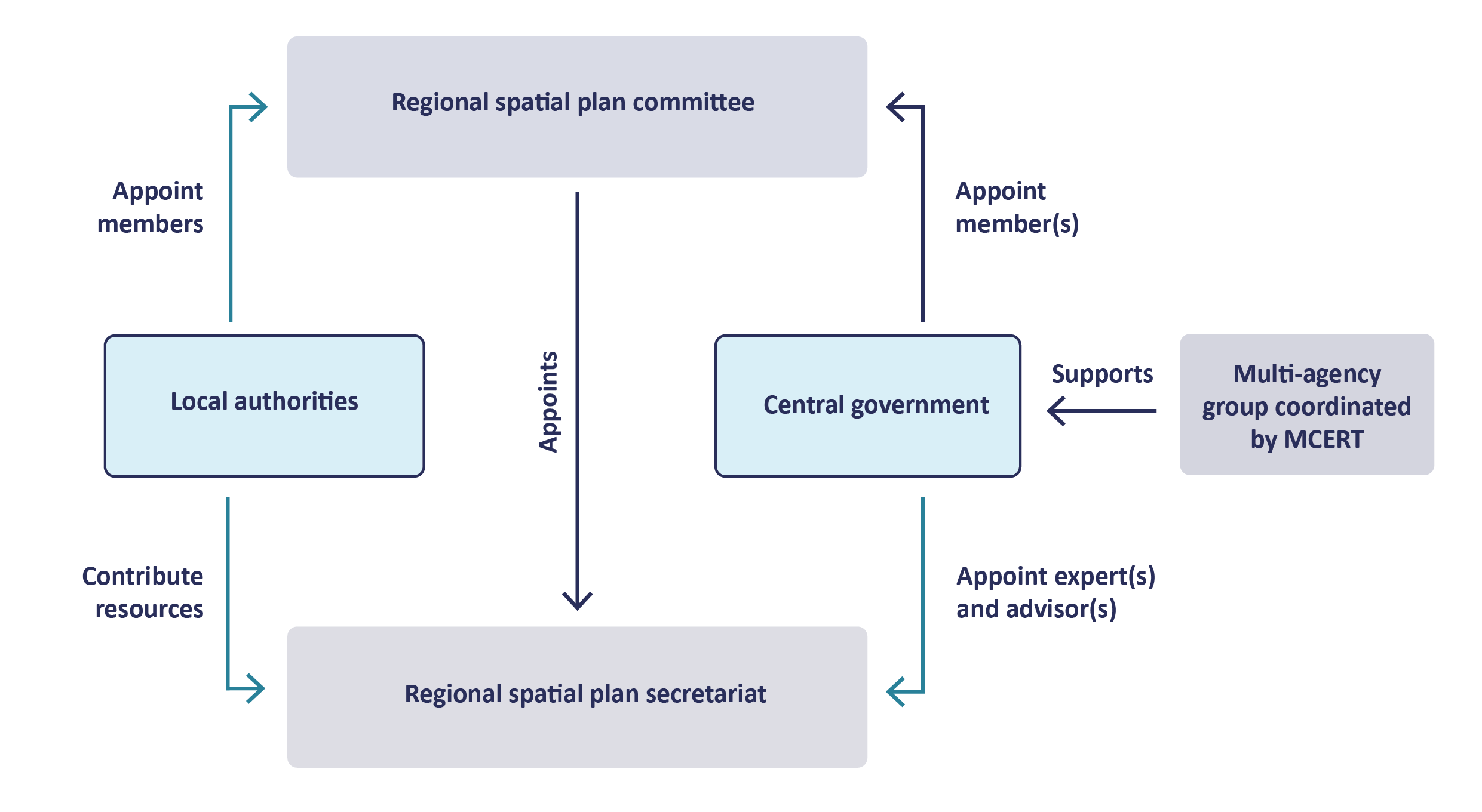
Each group has different roles and responsibilities in the spatial plan process. These are outlined in the table below and more detailed guidance on committees and secretariats will be available soon.
Under the Planning Act, the spatial plan committee is responsible for all the activities in the spatial plan committee and spatial plan secretariat column. The secretariat’s role is to provide the committee with technical and administrative support.
The table presents ways the work could be divided between the spatial plan committee and secretariat. The specific split of functions should be agreed by the local authorities and spatial plan committee.
Table 1: Responsibilities for developing spatial plans
| Local authorities | Central government | Spatial plan committee | Spatial plan secretariat |
|---|---|---|---|
| Owns the regional spatial plan | Contributes to spatial plan development | Acts as governance for the spatial plan | Prepares the spatial plan |
| Work together to prepare a process agreement (Schedule 2, cl 4) | May appoint one or more members to committee (section 82) | Appoints a chairperson (section 82) | Consults with iwi, communities, infrastructure providers, central government and others during spatial plan development |
| Work together to appoint the committee (section 82) | Must appoint and fund one or more experts or advisors to secretariat (section 83) | Appoints secretariat (section 83) | Drafts the spatial plan |
| Agrees how the secretariat will be established and managed (Schedule 2, cl 4) | May audit a spatial plan (Schedule 2, cl 16) | Responsible for governance and oversight of preparing draft spatial plan (and amendments to spatial plan), including pre-notification consultation and options assessment (Schedule 2, cl 3, 8, 9, 15) | Analyses options and prepares options assessment report (Schedule 2, cl 15) |
| Contributes resources to the secretariat | May make decisions on certain IHP recommendations (Schedule 2, cl 27) | Recommends draft spatial plan to local authorities for approval to notify (Schedule 2, cl 17) | Publicly notifies and receives submissions on draft spatial plan (Schedule 2, cl 18) |
| Approves draft spatial plan for notification (Schedule 2, cl 17) | A representative must attend IHP hearing (Schedule 2, cl 22) | Provides information to IHP (Schedule 2, cl 21) | |
| Appoints an independent hearings panel (IHP) (Schedule 2, cl 20) | May provide advice to local authorities on IHP recommendations, if requested (Schedule 2, cl 24) | Drafts the implementation plan | |
| May request advice from committee on IHP recommendations (Schedule 2, cl 24) | Responsible for governance and oversight of preparing and reviewing implementation plan (sections 84 and 85) | Carries out monitoring and reporting on implementation | |
| Makes decisions on IHP recommendations (schedule 2, cl 25) | Responsible for governance and oversight of monitoring and reporting on implementation (section 86) | Carries out reviews of the spatial plan | |
| Adopts regional spatial plan (Schedule 2, cl 34) | Responsible for governance and oversight of reviews (section 87) |
Appointing central government committee and secretariat members
Central government and Ministers will work to appoint committee members (where decided) and secretariat members across regions over the coming months.
Related pages
Timeframes and process for spatial planning
Learn about the key stages and timeframes for developing spatial plans.
How regional spatial plans work with other instruments and plans
Find out how regional spatial plans fit with other parts of the planning system.